Bitcoin slipped below $86,000 earlier today, December 1, as risk-off sentiment returned to crypto markets, triggering sizable liquidations and renewed volatility.
Key Takeaways:
- Bitcoin went as low as $85,600 after a fresh wave of selling caused the price to dip around 5% to 6% in 24 hours, pointing to profit-taking and squeezed leveraged positions.
- The decline triggered massive liquidations across crypto derivatives and dragged major altcoins like Ethereum and Solana lower.
- Technical indicators show elevated volatility and a fragile market, with spot liquidity flows and institutional order books expected to affect near-term moves.
What began as a modest pullback accelerated into a broader selloff as traders reduced exposure ahead of month-end positioning and macro headlines. Entering the month of December, Bitcoin dropped below the $86,000 mark after concentrated selling forced leveraged long positions to liquidate.
The ripple effect was felt across altcoins, with a surge in spot volumes signaling renewed market nervousness. Observers noted that this retracement resembles prior risk-off bursts seen earlier in November, highlighting persistent volatility as traders grapple with thin liquidity and profit-taking pressures. CoinGlass’ liquidation heatmap data revealed a massive $640 million in total liquidations in the last 24 hours amid broader crypto market crash, with the majority of long positions being liquidated around $565 million.
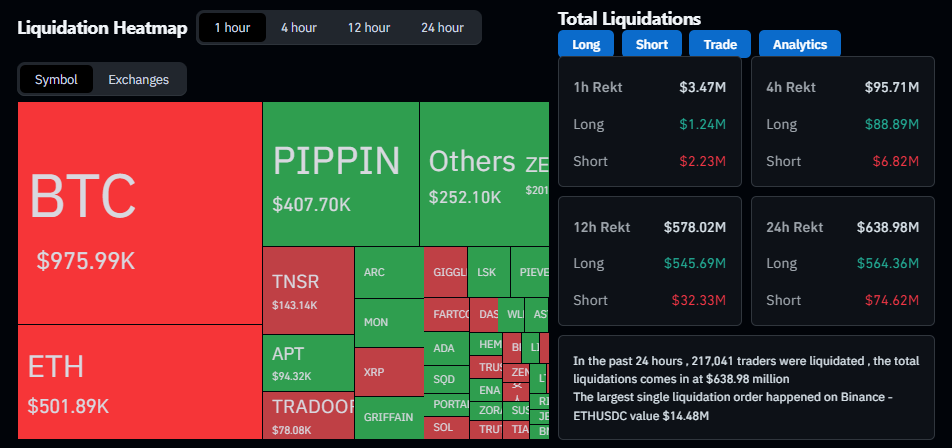
Traders faced a total of massive $638 million loss as their liquidated positions over the past 24 hours. Source: CoinGlass
BTC Shows Sharp Intraday Decline
As of this writing (6:45AM UTC), CoinMarketCap’s real-time market data shows Bitcoin (BTC) is trading at approximately $86,248.75, reflecting a significant 5.15% drop in the last 24 hours. CoinGecko’s live data, on the other hand, shows Bitcoin topping intraday highs around $91,904.65 and touching intraday lows near $85,694.01, suggesting a significant volatility over the past 24 hours caused by the noticeable price decline.
Short-term technical indicators show that volatility is rising, as momentum oscillators have softened relative to last week’s bounce, suggesting that the market sits at a delicate inflection point.
Analysts Point to Thin Liquidity and Profit-Taking
As per crypto market experts, December tends to be seasonally thin for spot liquidity, which magnifies price swings when large orders execute. Main drivers, including profit-taking after October to November gains and macro uncertainty were cited, which resulted to the ongoing downtrend market since the past few weeks. While longer-term observers remain cautiously optimistic, they warned that near-term price action will be dictated by exchange flows, ETF reallocations, and whether buyers emerge near key support zones.
Outlook
Analysts and experts suggest that traders and investors should watch closely particularly the spot liquidity, derivatives funding rates, and institutional flows. A visible stabilization in ETF and large order activity could halt the ongoing price decline, while continuous and significant outflows may push BTC further toward lower support zones. The recent Bitcoin price decline highlights the ongoing risk in highly leveraged markets and the importance of managing exposure during periods of thin liquidity. The $80k–$86k zone will likely determine whether this December selloff is temporary or the beginning of a broader consolidation.
Summary
Bitcoin fell under $86,000 on December 1 as a December selloff and large leveraged liquidations increased volatility, pushing major altcoins lower and highlighting the market's sensitivity to thin liquidity and large order flows.